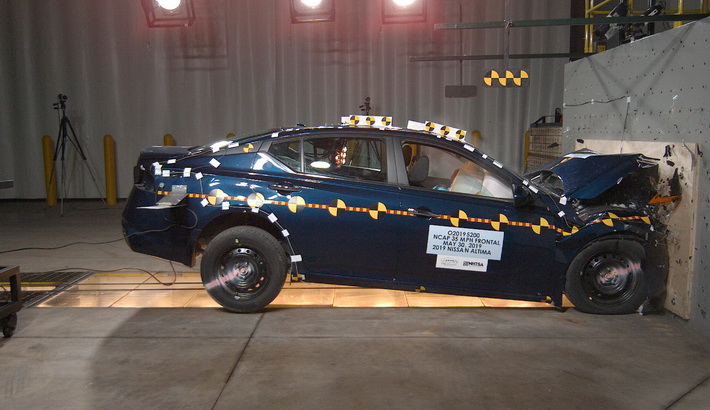
2020 NISSAN ALTIMA
2020 NISSAN ALTIMA was matched by year, make, and model using official NHTSA vehicle data. 6 matching NHTSA safety recalls were returned for this year/make/model. 177 NHTSA consumer complaints were returned in the current lookup.

2020 NISSAN ALTIMA was matched by year, make, and model using official NHTSA vehicle data. 6 matching NHTSA safety recalls were returned for this year/make/model. 177 NHTSA consumer complaints were returned in the current lookup.
Government crash-test scores are separate from Reviewboard's own score and opinion shown above.
What is wrong: Nissan North America, Inc. (Nissan) is recalling certain 2020-2021 Nissan Altima vehicles. The tie rod ball joint fastener was not tightened properly, which could result in the tie rod ball joint detaching from the steering knuckle.
Why it matters: A detached tie rod ball joint can cause a loss of steering control, and increase the risk of a crash.
How it will be fixed: Nissan will notify owners, and dealers will tighten the left and right-side tie rod ball joint fasteners, or install new fasteners as necessary, free of charge. The began March 31, 2021. Owners may contact Nissan customer service at 1-800-867-7769. Nissan's number for this recall is PC795.
Date reported to the U.S. government: 04/03/2021
What is wrong: Nissan North America, Inc. (Nissan) is recalling certain 2019-2020 Altima and 2018-2021 Titan vehicles equipped with Continental tires. On the affected vehicles, it is possible that one or more tires were cured for too long during tire production.
Why it matters: Over cured tires may develop a break in the sidewall, resulting in sudden air loss or belt edge separation which could lead to tread/belt loss. Either condition can cause a loss of vehicle control, increasing the risk of a crash.
How it will be fixed: Nissan will notify owners, and dealers will inspect the tires, and replace them as necessary, free of charge. Owner notification letters were mailed on May 11, 2021. Owners may contact Nissan customer service at 1-800-867-7669. Nissan's number for this recall is PC798.
Date reported to the U.S. government: 11/03/2021
What is wrong: Nissan North America, Inc. (Nissan) is recalling certain 2020 Altima, Maxima and Leaf vehicles. The rear window glass may not remain properly secured to the vehicle.
Why it matters: Rear window glass that separates from the vehicle can increase the risk of a crash.
How it will be fixed: Nissan will notify owners, and dealers will replace the back window glass, free of charge. The recall began November 4, 2020. Owners may contact Nissan customer service at 1-800-867-7669. Nissan's number for this recall is PC752.
Date reported to the U.S. government: 22/09/2020
What is wrong: Nissan North America, Inc. (Nissan) is recalling certain 2020 Altima S grade vehicles equipped with Continental ProContact TX tires, size 215/60 R16 H, with TIN date code 3320 and Mold ID S-419149. The tires may have been over cured.
Why it matters: Over cured tires can result in a sidewall break causing a sudden loss of air or the tread separating from the tire. Both conditions increase the risk of a crash.
How it will be fixed: Nissan will notify owners, and dealers will inspect the vehicle's tires to see if they are affected, replacing them as necessary, free of charge. The recall began December 10, 2020. Owners may contact Nissan customer service at 1-800-8677669. Nissan's number for this recall is PC765.
Date reported to the U.S. government: 05/11/2020
What is wrong: Nissan North America, Inc. (Nissan) is recalling certain 2019-2021 Altima and 2020-2021 Sentra vehicles. Damage to the camera harness can cause distortion or loss of the rearview camera display image. As such, these vehicles fail to comply with the requirements of Federal Motor Vehicle Safety Standard number 111, "Rear Visibility."
Why it matters: A rearview camera that does not properly display an image can reduce the driver's rear view, increasing the risk of a crash.
How it will be fixed: Dealers will inspect the rearview camera and harness for damage and replace them as necessary. If no damage is found, the dealer will apply protective tape and reroute the rearview camera harness. Repairs will be performed free of charge. Owner notification letters are expected to be mailed October 19, 2023. Owners may contact Nissan's customer service at 1-800-867-7669. Nissan's number for this recall is R23C3.
Date reported to the U.S. government: 08/09/2023
What is wrong: Nissan North America, Inc. (Nissan) is recalling certain 2021-2024 Rogue, 2019-2020 Altima, 2019-2022 Infiniti QX50, and 2022 Infiniti QX55 vehicles equipped with 3-cylinder 1.5L or 4-cylinder 2.0L variable compression turbo (VC-Turbo) engines. The engine bearings may have manufacturing defects that can lead to engine failure.
Why it matters: Engine failure increases the risk of a crash. A bearing failure may cause a breach in the engine block, allowing hot oil to be discharged, increasing the risk of an engine fire.
How it will be fixed: Dealers will reprogram the engine control module (ECM) software, free of charge. Owner letters were mailed April 8, 2026. Owners may contact Nissan's customer service at 800-647-7261 or Infiniti's customer service at 1-800-662-6200. Nissan's numbers for this recall are R25A8/A9 and R25B1/B2.
Date reported to the U.S. government: 27/06/2025
2020 NISSAN ALTIMA was matched by year, make, and model using official NHTSA vehicle data. 6 matching NHTSA safety recalls were returned for this year/make/model. 177 NHTSA consumer complaints were returned in the current lookup.
The 2020 Nissan Altima is a vehicle that presents a complex picture for potential buyers, especially when considering long-term reliability and safety concerns. Based on comprehensive editorial analysis of owner feedback and official reports, this vehicle has been assigned a Reviewboard rating of 52.3 out of 100, which corresponds to a "poor" opinion. This score reflects significant reservations regarding the overall ownership experience, despite some inherent strengths, making it a cautious choice for ordinary shoppers.
The Altima is positioned as a comfortable sedan, offering a generally smooth driving experience. However, this comfort does not mitigate the substantial concerns surrounding its mechanical reliability and safety components. The negative sentiment among owners highlights persistent worries about long-term dependability, particularly concerning the transmission systems and various mechanical parts that require attention over time.
The reasons behind the "poor" rating are rooted in a significant volume of reported issues and official recalls affecting the vehicle. In total, the vehicle has accumulated 177 consumer complaints and reports documented by owners. These concerns are not isolated; they touch upon critical areas of the vehicle, including the electrical system, the engine, steering mechanisms, and other unknown or other mechanical components. This high volume of reported problems signals that potential buyers should approach this vehicle with extreme caution and conduct thorough inspections before making a purchase.
The Reviewboard analysis focused on several specific areas where concerns were most acute. These included issues related to the steering linkages, tires, visibility glass, the rearview camera sensing system, and internal engine components. The presence of these documented problems suggests that maintenance and potential repairs may become a significant factor in the vehicle's total cost of ownership.
Safety and recalls are particularly important considerations for any buyer. While the vehicle’s official safety ratings from government testing provide a baseline assessment, the existence of multiple recalls indicates specific mechanical issues that Nissan has identified as requiring correction. For example, there have been recalls concerning components such as the steering tie rod assembly, tires, rear window glass, and the rearview camera harness. These recalls are issued because certain parts or systems pose risks to vehicle control or visibility, increasing the potential for a crash. Buyers must verify that any necessary repairs related to these recalls are properly addressed by a qualified dealer to ensure the vehicle operates safely and legally.
The concerns extend beyond immediate safety issues into the realm of long-term mechanical reliability. Owner feedback frequently points toward persistent worries about the performance and longevity of certain components, most notably the transmission systems. While the engines themselves are generally noted as robust, the potential for costly transmission issues means that owners must anticipate diligent maintenance and be prepared for potential expensive repairs down the line. This factor significantly impacts the overall value proposition when comparing the vehicle’s market price—estimated around $18,500 USD—against its actual long-term reliability record.
When evaluating this vehicle, prospective buyers should understand that the reported issues are not merely minor annoyances but represent systemic concerns documented by a large group of owners. The high number of complaints suggests that potential problems related to the electrical system and engine performance need careful scrutiny. Buyers should verify the condition of all listed components, paying close attention to steering, braking, and electrical systems, as these were highlighted among the most frequently reported areas of concern.
Who should consider the 2020 Nissan Altima? This vehicle may be suitable for buyers who are willing to accept a higher degree of risk regarding mechanical reliability and who are prepared to invest significant time and resources into pre-purchase inspections and ongoing maintenance. It is not recommended for those prioritizing absolute, worry-free dependability above all else.
What should a buyer verify? Before committing to the purchase, prospective owners must thoroughly investigate the history of the specific vehicle they are considering. This involves looking beyond official safety ratings to examine the documented owner complaints and recall history. Buyers should seek out detailed information regarding the maintenance history and potential repair costs associated with the components that have been flagged by the Reviewboard analysis—specifically steering linkages, tires, engine cooling systems, and electrical components. Verifying that all outstanding recalls have been properly addressed is non-negotiable for safety.
In conclusion, while the 2020 Nissan Altima offers a comfortable ride, the aggregated data paints a picture of a vehicle with notable reliability and safety concerns. The Reviewboard score of 52.3 out of 100 and the "poor" opinion are consistent with the extensive list of documented issues, including multiple recalls and widespread owner complaints regarding critical systems like the engine, steering, and tires. Buyers must weigh the comfort of the vehicle against the known potential for costly mechanical problems and safety risks. Given the volume of reported defects and the necessity of addressing multiple recalls, the current buying recommendation is cautious: proceed only after a meticulous verification process has been completed.
When moving forward with a purchase of this vehicle, prospective buyers must treat the documented issues not as minor inconveniences but as potential liabilities that directly impact safety and financial planning. The 177 consumer complaints indicate a pattern of dissatisfaction among owners, suggesting that mechanical failures are more common than in average vehicles. This volume of feedback strongly suggests that routine maintenance may be insufficient or that specific components require attention beyond standard servicing. Therefore, before any transaction is finalized, buyers should insist on a comprehensive pre-purchase inspection that specifically targets the areas flagged by the Reviewboard analysis: the electrical system, steering linkages, and engine components. Ask sellers for detailed records of all previous maintenance and repair history, focusing particularly on work done related to the transmission and major mechanical systems. Understanding the history of repairs can reveal whether the vehicle has been subjected to the types of issues documented in the recalls—such as those concerning tire curing or engine bearings—and if those problems have been adequately resolved.
Practical guidance dictates that buyers should prioritize verifying the status of all outstanding recalls. The list includes critical safety components like steering tie rod assemblies and tires, as well as visibility features such as rear window glass and the rearview camera system. A vehicle is only safe to operate when it fully complies with all federal safety standards; therefore, ensuring that every recall listed in the evidence has been addressed by a certified mechanic is an essential step. Do not assume that because a vehicle passes basic government crash tests, it is free from mechanical defects or necessary repairs. The potential for costly fixes related to engine failures and transmission concerns must be factored into the total cost of ownership. If a seller cannot provide verifiable proof that all relevant recalls have been completed, this represents a significant red flag demanding further investigation.
Ultimately, the decision rests on balancing perceived comfort against documented risk. While the 2020 Nissan Altima offers a comfortable daily drive, the aggregated evidence points toward a vehicle where mechanical reliability is a known variable. The concerns surrounding the engine and transmission systems, coupled with the multiple safety-related recalls, place this vehicle firmly in a category requiring extreme caution. Buyers should only consider this model if they have the resources and willingness to manage potential future maintenance costs associated with these documented issues. Based on the extensive body of owner feedback and official reports detailing mechanical faults and safety concerns, the final recommendation remains cautious: the 2020 Nissan Altima is not recommended for general shoppers seeking a reliable and worry-free ownership experience. The Reviewboard rating is 52.3 out of 100, and the opinion is poor.
Public buyer feedback skews negative. Checked 5 public results with 3 positive and 31 negative cues. One public result noted: The 2020 Nissan Altima scores 71/100 (Good) with 6 recalls and 162 owner complaints . Full breakdown of issues, safety ratings, and repair costs.