
Politics
Be Quiet: Inside Trump’s War on the White House Press
The second Trump administration has turned press access into a weapon, banning outlets, seizing the press pool, and confronting reporters on the sidewalk. The confrontation is personal, public, and rewriting the rules of the briefing room.
The Gatekeepers
It begins with a name on a list. In September 2026, the White House told CNN, MS NOW and Politico they were no longer welcome inside. The announcement came on Truth Social on September 18, with Trump saying the ban was because they were reporting what he called FAKE NEWS. He said the news organizations purposely write negative news in order to try and diminish the Republicans and a Republican administration. Effective immediately, the three outlets lost their hard passes, their briefing room seats, their place in the rotation.
The press corps pushed back. The outlets sued, calling it a blatant violation of the First Amendment. A federal judge, Timothy Kelly, sided with them and ordered the administration to restore access. The journalists tried to enter the White House on Thursday morning and were not granted entry until midday. Hours later, CNN’s editorial team along with an MS NOW reporter were blocked from covering the state dinner commemorating Chinese President Xi Jinping’s visit. The ban held, and the protest became a practice: the television pool said it would suspend video coverage of Trump in protest.
The White House defended the move with history. A press release on September 21 said access changes are nothing new, and that Democrat administrations have restricted, punished, and locked out the press for years. The release listed examples from Obama and Biden. Ken Paulson, director of the Free Speech Center at Middle Tennessee State University, told FactCheck.org there is no basis to suggest Biden and Obama did it too. Trump’s action is singular and unprecedented, he said, noting Trump has instituted a full ban of multiple news media and is targeting news organizations because they are publishing content he finds unflattering. That violates the First Amendment prohibition against government using its power to punish ideas.
Amy Kristin Sanders, a professor of First Amendment studies at Penn State, said the action was unprecedented, particularly when taken in light of President Trump’s public stance about why he banned the news organizations. What the Trump administration has done is revoke access for news organizations that have already been granted press access while publicly saying it is because President Trump doesn’t like the way he is being covered, she said. These outlets are being targeted specifically because they engaged in critical coverage.
A Word That Echoes
The comparison is always made with Barack Obama. Critics of Trump have compared his hostility toward the media with how the former president handled journalists. The quote circulates on social media: at his final news conference as president in 2017, Obama told reporters, You’re not supposed to be sycophants. You’re supposed to be skeptics. You’re supposed to ask me tough questions. You’re not supposed to be complimentary, but you’re supposed to cast a critical eye on folks who hold enormous power and make sure that we are accountable to the people who sent us here.
The quote is correctly attributed. In a video of Obama’s final news conference, he says those words. The point of the comparison is not equivalence. In 2009, early in his presidency, the Obama White House questioned whether Fox News was a legitimate news organization and excluded Fox News Sunday when the president made the rounds on all of the other Sunday news talk shows. The Treasury Department reportedly tried to limit access for Fox News to an interview with an administration official. Other news organizations objected and supported Fox, and it never occurred again. Continuance of that practice would have raised significant First Amendment questions.
The White House press release used those episodes as precedent. The press corps and legal experts draw a line between a spat and a ban. The difference, they say, is the public rationale. Trump said he was doing this because they’re fake news. He said the news organizations purposely write negative news.
The Pool Shrinks
Control of the press pool is control of the story. Since the beginning of Trump’s second administration in 2025, the White House has decided which outlets cover the president via the pool each day, a task previously coordinated by the White House Correspondents’ Association. The pool is a rotating group of journalists charged with covering presidential travel and disseminating written and multimedia reports to news outlets that may not be present at a given White House event.
Last weekend the pool suspended its video coverage of Trump in protest. On Saturday, Trump left the White House early and stepped into the glare of cameras. MS NOW White House correspondent Akayla Gardner asked him: Do you only want outlets that support you to be a part of the press pool? Trump replied, No, no, no. I want real news, not fake news – like you.
Gardner pressed: Do you not want tough questions? Be quiet, Trump said, before continuing to air his familiar grievance that their reporting on him is not flattering enough.
Since his first presidency, Trump has labeled nonpartisan news outlets that do not openly support him the enemy of the people, maligning unfavorable reports as fake news. In his second term, he has increasingly told female reporters who ask him challenging questions to be quiet. Tensions with the press corps soared to new heights last weekend, when administration officials revoked the White House credentials of MS NOW, Politico and CNN after Trump announced what he himself called a ban on the free press.
A day after the ban, Trump posted on Truth Social early on Saturday: Why should perpetrators of FAKE NEWS be allowed access to a very sacred place, the White House? Despite my big Election Win, almost 100 percent of TRUMP coverage is negative, and has been for years. The post singled out CNN and MS NOW, referring to the latter as MSDNC, which combined the outlet’s name with the Democratic National Committee. The post came days after a Reuters/Ipsos poll found Trump’s overall public approval rating to be at 32 percent, an all-time low.
Air Force One, No Seat
The confrontation moved from the briefing room to the tarmac. The White House blocked CNN from traveling aboard Air Force One on Saturday, impeding its TV press pool duties in the latest escalation of the administration’s battle with the news media. CNN had been scheduled to fly with Donald Trump to Tennessee for a college football game, the network said on Friday. The White House confirmed CNN’s exclusion when it did not list the network on guidance sent to the press corps regarding Trump’s schedule for Saturday.
Real America’s Voice, a pro-Trump network that lacks the technical capability to provide live video for other broadcasters, instead accompanied the president during the brief trip. The partisan, rightwing network shared a limited number of clips of the trip on social media, including video of Trump’s image being displayed on the stadium’s big screen, which it captioned: PRESIDENT TRUMP LIGHTS UP THE JUMBOTRON.
Trump returned to Washington DC on Saturday afternoon without taking questions from the print reporters who were permitted to accompany him. Brian Stelter, CNN’s chief media analyst, said on air about the network’s exclusion from Air Force One: He is picking a fight with the people who are telling unpleasant truths about his administration. Today, yes, it happens to be CNN, but tomorrow it could be any other news outlet.
The public interest argument was made in a joint statement Monday by the White House television pool: The public has a vital interest in receiving accurate, independent information about its government. No administration should restrict a news organization because it objects to its reporting.
The Justice Department’s attorneys suggested the ban was in the interest of national security, pointing at media reports involving sensitive and classified information. CNN, MS NOW and Politico argued in a subsequent lawsuit that the White House ban was a violation of the first amendment. A hearing was held on September 23.
A Show With No Exit
The week of the ban coincided with a state dinner for Xi Jinping. Chinese state media were welcome at the White House, unlike CNN, MS NOW and Politico. The summit offered a staged display of friendship, but little movement on substance. Expectations were low after May’s stalemate summit in Beijing, but this meeting still struggled to meet them.
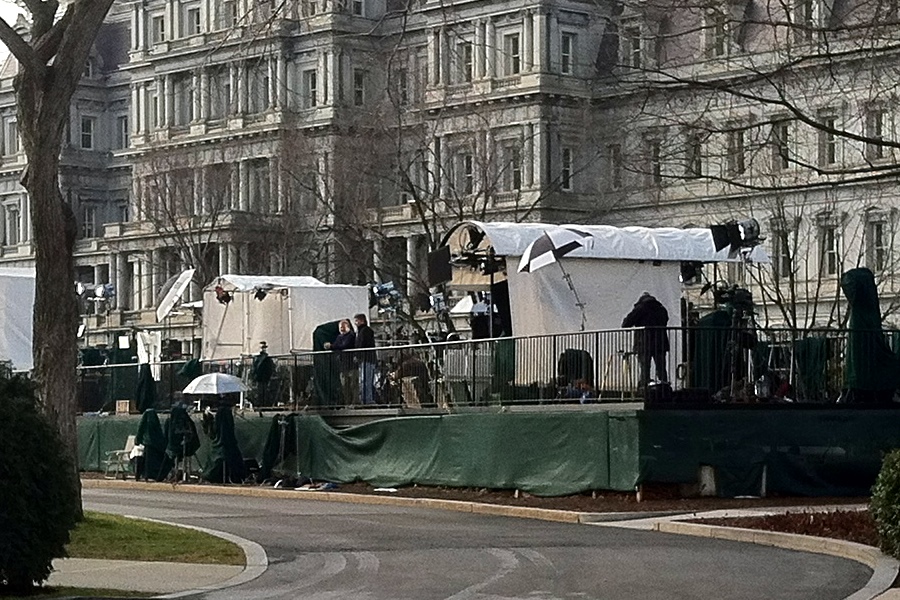
At the dinner, while domestic outlets were barred, the access question was not abstract. It was felt in the press room, on the sidewalk outside the White House, and in the cabin of Air Force One. The administration is arguing that the First Amendment protects their right to publish; it does not entitle them to a hard pass, briefing room seat, or place in the press pool. Critics say that argument misses the point: when the White House opens its facilities to the press generally, it cannot exclude reporters based on disapproval of their views.
The ban is not a moment. It is a pattern. The press pool is no longer a cooperative rotation; it is a permission slip. The briefing room is a stage managed by the communications team. Reporters who ask tough questions are told to be quiet. The narrative that emerges is no longer shaped only by what the president does, but by who is allowed to witness it.
In the long arc of American press relations, the question is not whether a president is annoyed by coverage. Presidents have always been annoyed. The question is whether access can be withdrawn as punishment for coverage, and whether the public can still see the work of government without a gatekeeper deciding who gets to look. The administration says this is access, not censorship. The press corps says it is both. The sidewalk outside the White House has become the new briefing room, and the answers are getting shorter.
In September 2026, the White House told CNN, MS NOW and Politico they were no longer welcome inside.
Want our sources?
Enter your email and we’ll send the claim-linked sources used for this article.
We use this address only to send this source list.