
Politics
The Night the Press Was Kept Outside
A state dinner for Xi Jinping was meant to showcase American hospitality. Instead it became the stage for a standoff over White House access, with a federal court order set aside at the gate and a televised dinner that never aired.
The Arrival
The South Lawn had been set for a different kind of ceremony. President Trump welcomed Xi Jinping with a military review, the kind of choreography that usually feeds the rotating pool of network cameras that travel with the president and trade images among ABC, CBS, NBC, Fox News and CNN. The White House said the evening would be a “Toast to Peace.” The menu was a three-course American meal with a subtle Chinese influence: sea bass and bok choy. The guest list read like a roster of American power in the 21st century — tech titans including Jeff Bezos, Elon Musk, Jensen Huang, Sam Altman and Tim Cook were among those invited, alongside investors, Supreme Court justices and Fox News hosts.
The first visit by a Chinese leader to Washington in more than ten years was billed as a summit about trade, technology, Iran and Taiwan. The U.S. and China agreed to extend what they called a trade truce: the U.S. would not raise tariffs on Beijing and Beijing would continue to allow the export of rare earth magnets essential for cell phones, electric vehicles and F-35s. On artificial intelligence, the two sides launched a U.S.-China AI Dialogue and Treasury Secretary Scott Bessent proposed a dedicated communications line to report national security AI incidents. Xi said cooperation over AI was possible, that the development of AI should be always under human control and serve the well-being of the people. Trump said, “We’re leading AI over China by a lot. We’re going to keep it that way.”
The public remarks were friendly. Trump said he and Xi had forged a truly great friendship and called it a great meeting. Xi spoke of constructive strategic stability and said achieving the great rejuvenation of the Chinese nation and making America great again could go hand in hand. Behind the remarks, U.S. officials acknowledged that Beijing had raised the possibility of canceling the summits if a second arms package to Taiwan were announced, and that the U.S. held the package in abeyance because it feared China would send more weapons to Iran.
The Ban
The summit unfolded against a separate fight over access. Earlier in September the White House had banned CNN, MS NOW and Politico from the White House, accusing them of writing “fiction or lies” about his administration. The outlets sued, calling it a blatant violation of the First Amendment. The ban sparked a boycott: Fox News, ABC, NBC and CBS said they would halt television coverage until restrictions were lifted. As a result, Trump inaugurated the presidential residence’s new helipad without any sound on Sept. 21.
In court, the administration argued access changes were nothing new and that Democrat administrations had restricted the press for years. A federal judge was skeptical. Judge Timothy Kelly heard arguments about due process and the revocation of hard passes. He issued an early morning order forcing the administration to return access for a 14-day period, finding the ban likely violated constitutional due process rights and that plaintiffs were likely to succeed in showing their hard passes were revoked without constitutionally adequate due process. The judge wrote that before a press pass can be revoked the White House must promulgate rules or standards governing conduct that would lead to revocation and reporters must receive fair notice of the conduct and the magnitude of the sanction.
White House Director of Press Operations Micah Stopperich filed a sworn statement that the operations team was notified at 7:10 a.m. to restore access and began reinstating badges at 7:25 a.m. The Secret Service said passes were re-activated as of 9:07 a.m. and confiscated badges were dropped off at the entry just before 10 a.m. Journalists from CNN, MS NOW and Politico were allowed back in on Thursday morning after days of being barred.
The Gate
The restoration did not hold for the evening. About an hour before Xi’s arrival was scheduled, the White House told CNN it could cover the event only with a photojournalist and audio technician, notably excluding the network’s editorial team consisting of a reporter and producer. MS NOW White House reporter Laura Barrón-López was prevented from covering Xi’s arrival for the state dinner despite applying for credentials. When she asked a White House staffer why she was denied access, the staffer said she should talk to Steven, apparently meaning White House communications director Steven Cheung.
CNN and MS NOW journalists were denied access to the White House state dinner in honor of Xi Jinping hours after a federal judge ruled the Trump administration must allow them in. The live YouTube stream of Xi’s arrival attracted just 18,000 views. None of the major U.S. networks provided live broadcast video of the event after the Trump administration refused to allow a CNN reporter and producer to cover the event. The White House TV pool remained suspended.
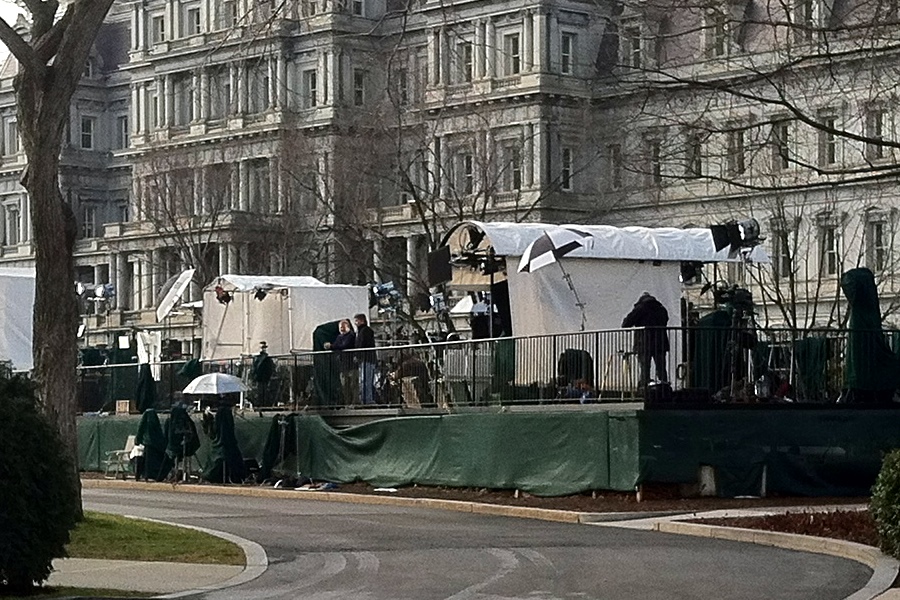
The networks that normally pool resources and take turns providing sound and images for live coverage of the president stayed away. The evening unfolded without the familiar rotation of cameras that normally carries the president’s movements to the public. A monitor showed CNN senior reporter Betsy Klein doing a live report from the designated outdoor press area on the North Lawn after being allowed back on the grounds, a reminder of how close and how far access had become.
A Silent Pool
The absence was audible. Outside the White House gate a group of demonstrators shouted slogans as Trump and Xi posed for photographs on the red-carpeted steps. The protests were clearly audible. Inside, the dinner proceeded with the Chinese leader and his wife Peng Liyuan, with First Lady Melania Trump and President Trump posing near a painting Trump had hung of himself raising his fist after a 2024 assassination attempt.
The White House communications account posted on X that contrary to what the Fake News wants you to believe, they don’t just get to have free rein into every part of the White House, every event, and every press call. Trump later complained about the lack of TV coverage stemming from his own effort to ban CNN.
The boycott created a strange vacuum. Coverage was limited to the White House’s own YouTube stream and to reporters who were permitted on the grounds but not inside the room where the state dinner took place. The networks’ decision to withhold pool video meant the public saw the arrival and the handshakes, but not the conversation inside.
The Summit Behind the Curtain
Even with the press dispute, the substantive agenda pressed forward. The U.S. and China were talking about trade technology and Taiwan, and this year Iran. A senior U.S. official said Americans had died in Iranian attacks in the Middle East as a result of Chinese actions, and the U.S. wanted those actions stopped. On Taiwan, the Trump administration had authorized the largest ever arms package and previewed a second package, but as of that day the second package had not been announced.
Xi urged the U.S. to oppose Taiwanese independence, according to a readout from the official Chinese news agency Xinhua shortly after the meeting concluded. The White House did not immediately provide its own summary. The two leaders repeated the phrase constructive strategic stability, meaning the issues would not lead to conflict or a larger confrontation.
All of that was said in rooms the press could not enter. The dinner was a tableau of diplomacy staged for cameras that were not there. The ban, the court order, the partial restoration and the final denial at the gate turned an evening meant to display hospitality into a demonstration of how access itself had become a political instrument.
The night ended with a state dinner that was not televised, a court order that was honored in the morning and set aside in the evening, and a press corps that learned again that a hard pass is not a guarantee.
The South Lawn had been set for a different kind of ceremony.
Want our sources?
Enter your email and we’ll send the claim-linked sources used for this article.
We use this address only to send this source list.